
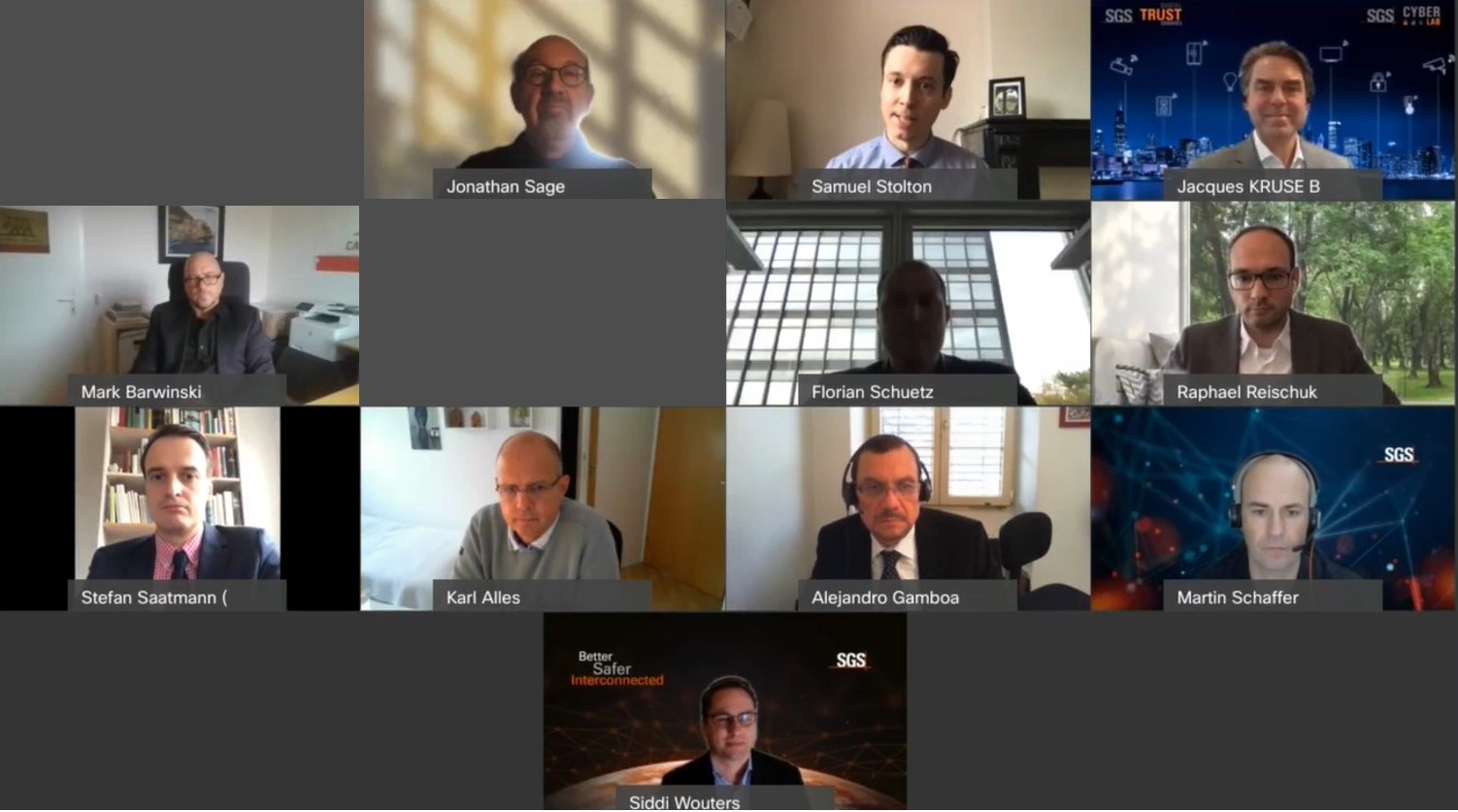
On 20 October, the Charter of Trust hosted its first-ever Geneva Roadshow with experts from Switzerland, from the World Trade Organization, as well as from Charter of Trust member companies. Discussions focused on how cybersecurity measures can be strengthened with collaboration in threat information sharing to increase the resilience of the digital supply chain amid growing cybersecurity threats.
The session was introduced by Siddi Wouters, Senior Vice President for Digital & Innovation at SGS, who argued that the evolving cybersecurity landscape called for harmonized cybersecurity requirements. Within the Charter of Trust, each member contributed with its own expertise in different parts of the digital supply chain to effectively promote and ensure trust. The launch of the SGS-TU Graz IT security research, education, testing and certification hub in the coming weeks was a concrete illustration of the ongoing work to strengthen cybersecurity resilience.
Florian Schütz, Swiss Federal Cyber Security Delegate, gave a keynote speech on the Swiss Cybersecurity Strategy, and highlighted how Switzerland approached current challenges in the field. For cybersecurity, Mr. Schütz argued that “hope and fear have never been good advisors” and better sharing of threat information between stakeholders was key.
Jacques Kruse Brandao, Global Head of Advocacy, Digital Trust Services at SGS, gave an introduction to the Charter of Trust and its 10 Principles. Against the development of professional hacking and growing cyber-risks, the Charter of Trust aimed to drive security in an insecure, connected world. Mr. Kruse Brandao was joined by Jonathan Sage, Government and Regulatory Affairs Executive at IBM, Karl Alles, Group Security Officer at Atos and Dr. Stefan Saatmann, Global Coordinator for Cybersecurity Policy at Siemens. The group presented how Charter of Trust members collaborate to implement the Charter’s 10 Principles.
This was followed by a panel discussion moderated by Samuel Stolton, Digital Editor at EurActiv:
Dr. Raphael M. Reischuk, Vice-President of the Cybersecurity Commission ICT Switzerland, presented the proposal for a Swiss Conformity Assessment Institute which aimed at increasing trust with certifications as ensuring conformity should not be left to the private sector alone.
Florian Schütz, Federal Cyber Security Delegate, noted that governments must take a macro-perspective of the supply chain as there are many different types of supply chains, and to ensure the integrity of the supply chain as a whole.
Alejandro Gamboa-Alder, Secretary of the Council for Trade in Goods at the World Trade Organization, argued that technology could make trade more secure thanks to e-certificates which were key to foster trust in global supply chains. Mr. Gamboa-Alder further stressed the need to report incidents without delay and mentioned the resistance of some stakeholders with regard to increasing transparency.
Mark Barwinski, Global Head of Cybersecurity Detection & Protection at Siemens, stressed that building resilience was of utmost importance, notably in a period when working from home had become the norm. Companies should therefore increase detection capabilities and enforce cyber hygiene measures. Moreover, the development of threat information sharing networks in Information Sharing and Analysis Centres (ISACs) and within the Charter of Trust helped build trust relationships that created value for each company.
Dr. Martin Schaffer, Global Head of Cybersecurity Services at SGS, noted that the proposal for a Swiss Conformity Assessment Institute was a relevant approach and constituted a complementary step to the Charter of Trust’s Principle 2 baseline requirements.
Jonathan Sage, Government and Regulatory Affairs Executive at IBM, stressed the importance to raise resilience with a risk-based approach to secure the supply chain.
Jacques Kruse Brandao concluded the discussion by inviting attendees to join the Charter of Trust Madrid Roadshow, which will take place on 3rd December, focusing on Spain’s cybersecurity strategy.

PREVIOUS POST
Charter of Trust elects new co-chairs of the Board of Directors
NEXT POST
A Quantum Leap for Cybersecurity: The Charter of Trust’s PQC Ambition

You may also like

 Emerging Technologies
A Quantum Leap for Cybersecurity: The Charter of Trust’s PQC Ambition
The Charter of Trust is taking decisive steps to secure our digital future in the quantum era. As quantum computing advances, the risks to today’s cryptographic systems grow ever more urgent. Our dedicated working group is leading the way in raising awareness, promoting standards-based migration, and fostering collaboration across industries, governments, and academia. Together, we are committed to a proactive, well-coordinated, and risk-driven transition to post-quantum cryptography—ensuring digital trust and resilience for generations to come. Discover our vision and join us as we shape a secure digital world for the quantum age.
Read more
October 14, 2026
•
 Emerging Technologies
Read the Charter's contribution to the European Commission's public consultation on the Digital Omnibus Package
The rapid expansion of EU digital regulation has strengthened security, privacy, and trust, but it has also created overlapping obligations, inconsistent timelines, and administrative complexity. The Digital Omnibus Package provides a timely opportunity to streamline these rules, ensure greater coherence, and enable businesses to focus resources on resilience and innovation rather than redundant compliance tasks.
The Charter of Trust welcomes the Commission’s initiative to harmonize digital regulations across the EU, aiming to reduce administrative burdens while maintaining high standards of security and privacy. Representing the unified views of its Partners, this paper addresses all key legislation within the scope of the Digital Omnibus and offers comprehensive recommendations. It emphasizes the need for a unified incident reporting system, risk-based notification requirements, and fair compliance processes to minimize regulatory overlap. The Charter calls for clearer liability clauses, global recognition of certifications, and stronger supply chain security.
In data regulation, the Charter advocates ensuring alignment between the rules on data intermediation services under the DGA and B2B data sharing under the Data Act and extending exemptions to mid-cap companies, all while safeguarding trade secrets. For artificial intelligence, the paper recommends a phased approach to new requirements, integrated conformity assessments, harmonized compliance templates, and clear definitions, supported by sector-specific guidance and transparent AI categorization. The Charter also encourages the European Commission to ensure that ePrivacy reform is future-proof, fosters innovation, and reflects the needs of both businesses and consumers. Finally, it recommends robust security standards and cross-border recognition for the EU Business Wallet, with industry involvement in technical standards and integration with data access systems.
Collectively, these measures are designed to foster innovation, resilience, and trust in the EU’s digital landscape, allowing businesses to thrive in a coherent and future-ready regulatory environment.
The Charter of Trust welcomes the Commission’s initiative to harmonize digital regulations across the EU, aiming to reduce administrative burdens while maintaining high standards of security and privacy. Representing the unified views of its Partners, this paper addresses all key legislation within the scope of the Digital Omnibus and offers comprehensive recommendations. It emphasizes the need for a unified incident reporting system, risk-based notification requirements, and fair compliance processes to minimize regulatory overlap. The Charter calls for clearer liability clauses, global recognition of certifications, and stronger supply chain security.
In data regulation, the Charter advocates ensuring alignment between the rules on data intermediation services under the DGA and B2B data sharing under the Data Act and extending exemptions to mid-cap companies, all while safeguarding trade secrets. For artificial intelligence, the paper recommends a phased approach to new requirements, integrated conformity assessments, harmonized compliance templates, and clear definitions, supported by sector-specific guidance and transparent AI categorization. The Charter also encourages the European Commission to ensure that ePrivacy reform is future-proof, fosters innovation, and reflects the needs of both businesses and consumers. Finally, it recommends robust security standards and cross-border recognition for the EU Business Wallet, with industry involvement in technical standards and integration with data access systems.
Collectively, these measures are designed to foster innovation, resilience, and trust in the EU’s digital landscape, allowing businesses to thrive in a coherent and future-ready regulatory environment.
Read more
October 14, 2025
•
 General announcements
Charter of Trust Welcomes Zscaler
We are thrilled to announce that we welcome Zscaler as the newest Partner to the Charter of Trust!
Zscaler is a leading cloud enterprise security provider helping global businesses accelerate their digital transformation by becoming more agile, efficient, resilient, and secure.
With Zscaler as a partner in the Charter of Trust, we aim to strengthen global cyber resilience through trust – by fostering actionable collaboration between industry leaders, governments, and public-private platforms. Zscaler brings robust expertise and innovation to the table, making it the ideal partner to drive this mission forward.
“Zscaler is excited to drive meaningful change alongside our new partners, laying a foundation of trust essential for successful digital transformation,” said Sam Curry, Zscaler CISO. “In today’s world, the need for reducing inherent trust and default access has never been greater. To truly stay ahead of ever-evolving threats, we must unite as a coalition of practitioners. Cyber attackers aren’t taking breaks, and with advancements like artificial intelligence, quantum cryptography, and emerging technologies on the horizon, collaboration is the key to securing the future.”
“We are proud to welcome Zscaler to the Charter of Trust. Their focus on cybersecurity innovation and commitment to openness reflect our shared ambition to create a safer, more resilient digital future. Together, we’ll strengthen trust, transparency, and security across the global digital landscape.” highlighted Dr. Summit Chada, Charter of Trust Co-Chair and COO Group Security & Business Lines CISO at Atos.
“With Zscaler as a Partner of the Charter of Trust, we believe that we can strengthen the global commitment to secure digital transformation by combining technological innovation with the Charter of Trust’s collaborative approach to cybersecurity leadership.” Ralf Schneider, Charter of Trust Co-Chair and Senior Fellow and Head of Cybersecurity and NextGenIT Think Tank at Allianz SE, welcomes Zscaler to the Charter of Trust.
We are excited to join forces and work together to advance digital trust and security across industries.
Zscaler is a leading cloud enterprise security provider helping global businesses accelerate their digital transformation by becoming more agile, efficient, resilient, and secure.
With Zscaler as a partner in the Charter of Trust, we aim to strengthen global cyber resilience through trust – by fostering actionable collaboration between industry leaders, governments, and public-private platforms. Zscaler brings robust expertise and innovation to the table, making it the ideal partner to drive this mission forward.
“Zscaler is excited to drive meaningful change alongside our new partners, laying a foundation of trust essential for successful digital transformation,” said Sam Curry, Zscaler CISO. “In today’s world, the need for reducing inherent trust and default access has never been greater. To truly stay ahead of ever-evolving threats, we must unite as a coalition of practitioners. Cyber attackers aren’t taking breaks, and with advancements like artificial intelligence, quantum cryptography, and emerging technologies on the horizon, collaboration is the key to securing the future.”
“We are proud to welcome Zscaler to the Charter of Trust. Their focus on cybersecurity innovation and commitment to openness reflect our shared ambition to create a safer, more resilient digital future. Together, we’ll strengthen trust, transparency, and security across the global digital landscape.” highlighted Dr. Summit Chada, Charter of Trust Co-Chair and COO Group Security & Business Lines CISO at Atos.
“With Zscaler as a Partner of the Charter of Trust, we believe that we can strengthen the global commitment to secure digital transformation by combining technological innovation with the Charter of Trust’s collaborative approach to cybersecurity leadership.” Ralf Schneider, Charter of Trust Co-Chair and Senior Fellow and Head of Cybersecurity and NextGenIT Think Tank at Allianz SE, welcomes Zscaler to the Charter of Trust.
We are excited to join forces and work together to advance digital trust and security across industries.
Read more
September 29, 2025
•