

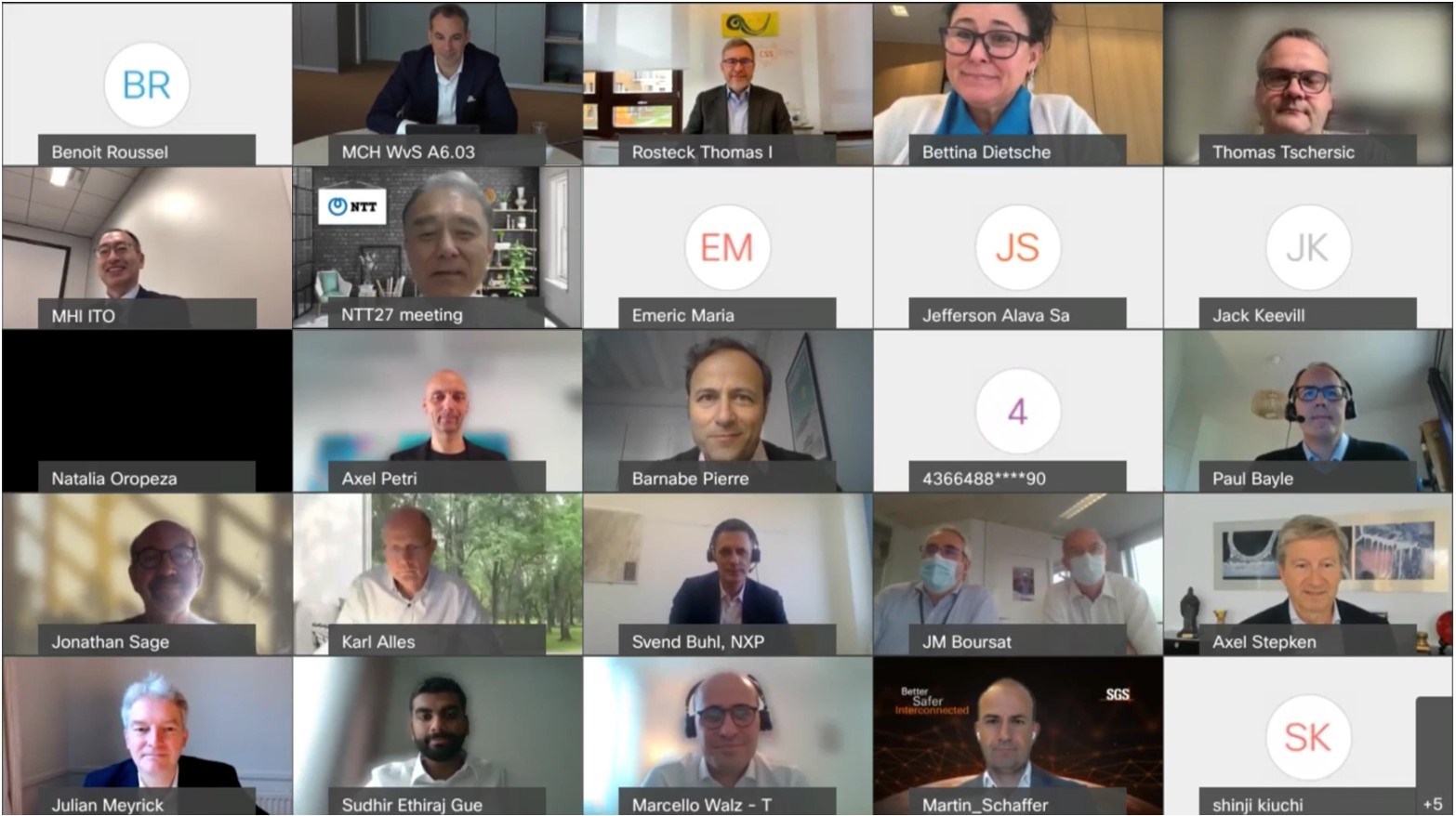
On October 22nd, the Charter of Trust’s Board of Directors, the highest decision-making body of the alliance, held its annual meeting to discuss and approve the Charter's course of action for 2021 and beyond.
The meeting was chaired by Mr. Cedric Neike, Member of the Managing Board of Siemens AG and CEO Digital Industries, and Ambassador Wolfgang Ischinger, Chairman of the Munich Security Conference.
All Charter of Trust members agreed that the past year, with the accelerated digitization but also increased cyber threats that resulted from the COVID-19 pandemic, internal cooperation across global industrial sectors – the raison d’être of the Charter of Trust – had become more relevant than ever. Members of the Charter of Trust therefore reaffirmed their determination to work towards fostering an ecosystem of trust where knowledge is shared, innovation encouraged, and resilience against cybersecurity threats improved.
Among the key steps endorsed by the Board of Directors was the decision to prepare the launch of a “Phase 2” in the Charter of Trust’s work. Building on and continuing the work conducted over the past 3 years to translate the Charter’s 10 Principles into Baseline Requirements and guidance documents, this new phase will seek to drive the concrete adoption and implementation of these principles in real life, thus maximizing the Charter’s contribution to a global ecosystem of trust. This will include the development of new strategies, indicators, and tools that will, among others, seek to increase best practice exchange and create a true knowledge-sharing community between Charter of Trust members.
The Board of Directors agreed to come together again to review progress ahead of the Munich Security Conference of February 2021, where it will celebrate its third anniversary and intends to formally launch the new phase of its work.


PREVIOUS POST
Richards Skalt takes over the Advocacy Workstream
NEXT POST
Charter of Trust launches Cyber Deterrence in the private sector

You may also like

 Cyber Deterrence
Charter of Trust launches Cyber Deterrence in the private sector
The Charter of Trust has launched its Cyber Deterrence Working Group to address a central gap in today’s cybersecurity landscape: the disconnect between strong defensive investments and the persistent economic attractiveness of cybercrime. The group brings together industry partners to develop and validate practical deterrence methods that raise attacker cost and risk across sectors and borders.
Read more
June 30, 2026
•
Post-Quantum Cryptography
Decrypting the Future: Global Timelines for PostQuantum Cryptography and why they matter
The transition to post-quantum cryptography is not a future problem — it is a present one. The threat of adversaries harvesting encrypted data today for decryption once quantum computing matures means that organizations with long-lived data and systems are already exposed. Waiting for cryptographically relevant quantum computers to arrive before acting is not a viable risk management strategy.
Exposure is not uniform across sectors. Financial services, government and defense, operational technology, and healthcare face the sharpest quantum risk, driven by decades-long data retention obligations, slow system replacement cycles, and the societal consequences of cryptographic failure. For these sectors, PQC readiness has moved from best practice to strategic imperative.
Globally, the direction of travel is clear. The United States, European Union, United Kingdom, Singapore, and Australia have each established structured PQC transition frameworks, with mandatory deadlines converging around the late 2020s and 2030. Organizations operating across jurisdictions should expect compounding compliance requirements and align migration plans accordingly.
At the same time, the geopolitical dimension of PQC standardization is becoming increasingly salient. The emergence of a “splinternet” infrastructure, characterized by regionally fragmented digital ecosystems, suggests that cryptographic standards diverge along political and strategic lines. As a result, organizations must not only manage technical migration but also navigate a politically charged landscape in which interoperability, regulatory alignment, and long-term cryptographic agility become critical strategic considerations.
This paper offers a comparative overview of regional PQC transition frameworks and identifies the business and systemic risks associated with quantum-vulnerable cryptography, providing insights for organizations preparing for the transition to post-quantum cryptography. Overall, PQC migration is a strategic transformation, not a technical patch. Cryptographic inventory, governance structures, crypto-agility, and supply chain engagement are as central to success as algorithm selection — and organizations that treat PQC readiness as an architectural and organizational challenge will be best positioned as quantum risks continue to mature.
Read more
April 07, 2026
•
Post-Quantum Cryptography
A Quantum Leap for Cybersecurity: The Charter of Trust’s PQC Ambition
The Charter of Trust is taking decisive steps to secure our digital future in the quantum era. As quantum computing advances, the risks to today’s cryptographic systems grow ever more urgent. Our dedicated working group is leading the way in raising awareness, promoting standards-based migration, and fostering collaboration across industries, governments, and academia. Together, we are committed to a proactive, well-coordinated, and risk-driven transition to post-quantum cryptography—ensuring digital trust and resilience for generations to come. Discover our vision and join us as we shape a secure digital world for the quantum age.
Read more
November 24, 2026
•


