


Emerging Technologies
Guide businesses on AI & Quantum Cryptography challenges.
The mission of this group is to address and provide guidance to businesses on how to manage the complexities triggered by AI and Post Quantum Cryptography and their impact on cybersecurity and trust.
AI is transforming the cybersecurity landscape for businesses, offering both unprecedented opportunities and complex challenges. On the positive side, AI enhances cybersecurity by automating threat detection, improving response times, and predicting potential security breaches through advanced analytics and machine learning algorithms. These capabilities enable businesses to proactively defend against cyber threats, minimize vulnerabilities, and enhance overall security posture.
However, the integration of AI also introduces new cybersecurity risks. AI systems can themselves become targets for cyberattacks, potentially being manipulated or exploited by malicious actors. Additionally, the complexity and opacity of some AI algorithms can make it difficult to identify and mitigate biases and vulnerabilities, leading to security gaps.
In light of the regulatory advancements on AI, the Charter of Trust Partners aim to provide clear guidelines for ensuring innovative but also secure and compliant with regulatory requirements.
Post-quantum safety represents a pivotal shift in the cybersecurity landscape, addressing the imminent threats posed by quantum cryptography to current cryptographic systems.
The impact of post-quantum safety on cybersecurity for businesses is profound. Implementing post-quantum cryptographic algorithms will become essential to safeguard data against future quantum attacks.
This involves transitioning to quantum-resistant encryption methods, which can be a complex and resource-intensive process, requiring significant updates to existing systems and protocols.
As such, the Charter of Trust Partners aim to provide the necessary guidance to critical businesses on how to adopt post-quantum safety measures and rethink their cybersecurity strategies to ensure long term resilience and security of their data.

Our AI workstream focuses on the implementation of the AI Act among other cybersecurity challenges and opportunities brought by these technologies. The work of our Partners in structured around the following topics:

BANNED PRACTICES
Support in assessing Partners’ AI systems, identifying information required for governance compliance and inform internal AI Governance Entity.

GPAI RULES
Work in 2025.

MINIMUM LITERARY REQUIREMENTS
Basic AI concepts, Ethical considerations and potential risks of AI, Data governance and privacy, Human oversight and the role of humans in AI systems, specific requirements for high-risk AI systems.

INTERNAL GOVERNANCE AND TRUST LABEL
Ongoing work.
Latest news, publications, events

 Emerging Technologies
AI Policy Paper
In this paper, our AI Working Group provides a clear framework for organisations to navigate this landscape, marked by concentrated provider ecosystems, fragmented global regulations, and geopolitical supply chain risks, alongside the internal requirements necessary to build AI responsibly.
A key aspect is helping organisations prepare for the EU AI Act, based on the overarching principle that compliance cannot be treated as a simple checklist exercise, and should instead drive strategic transformation. Organisations are encouraged to ensure visibility over all AI systems in use, promoting alignment across technical, legal, and business functions. Strengthening governance is equally critical. Executive level oversight, supported by operational teams, should lead to consistent, iterative risk assessment throughout the AI lifecycle, ensuring that performance, ethical, legal, and operational risks are identified and addressed early.
Companies must also balance compliance investments against the financial and reputational risks of non compliance. The penalties under the AI Act are substantial. However, proactive preparation not only reduces exposure, it can also create a competitive advantage by enabling faster innovation, strengthening customer relationships and regulator trust, and reducing uncertainty in product development.
Looking ahead, organisations should treat AI governance as a long term, adaptive discipline. Regulation and technology will continue evolving, and resilience depends on flexible policies, modular system architectures, and scalable governance processes.
Continuous monitoring of regulatory developments, active participation in standards setting activities, and sustained investment in skills are essential to fostering a responsible AI culture centred around a holistic understanding of compliance.
Please download the full report below.
 Emerging Technologies
A Quantum Leap for Cybersecurity: The Charter of Trust’s PQC Ambition
 Emerging Technologies
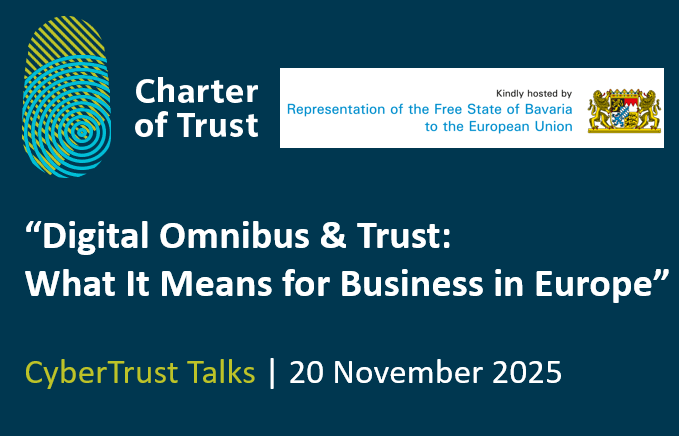
3rd CyberTrust Talk - Digital Omnibus & Trust - What it Means for Business in Europe?
With the European Commission unveiling its landmark Digital Omnibus Package just one day before, this event is your exclusive opportunity to be among the first to explore its real-world impact on business and the digital economy across Europe.
What to Expect:
Opening remarks by:
Dr. Armin Hartmuth, Director, Representation of the Free State of Bavaria to the European Union
Dr. Sumit Chanda, COO, Atos Group Security & Business Lines CISO, and Co-Chair of the Charter of Trust.
Keynote Address:
Despina Spanou, Deputy Director General for Cybersecurity and Trust, European Commission (DG CNECT), will share first-hand insights into the objectives and expected impact of the Digital Omnibus Package.
Expert Panel Discussion featuring:Moderated by Sudhir Ethiraj, Global Head of Cybersecurity Office, CEO Business Unit Cybersecurity Services, TÜV SÜD.
Despina Spanou, Deputy Director General for Cybersecurity and Trust, European Commission (DG CNECT)
Kia Slæbæk Jensen, Cyber Advisor, Permanent Representation of Denmark to the EU
Suzanne Button, Field CTO EMEA, Elastic
Tomas Jakimavicius, Director European Government Affairs, Microsoft
Yana Humen, AI and Cybersecurity Policy Manager, Government and Regulatory Affairs, IBM
Interactive Q&A: Bring your questions and join the conversation on regulatory coherence, innovation, and the future of digital governance in Europe.
Closing remarks by Maria del Pino Gonzalez-Junco, Director of the Charter of Trust
Networking Lunch: Connect with peers, policymakers, and industry leaders in an informal setting.
Why attend?
Gain first-hand insights into the EU’s Digital Omnibus Package—straight from the policymakers and experts shaping it.
Understand the immediate implications for your business and how to navigate upcoming changes.
Be part of a strategic dialogue that could influence the future of digital regulation in Europe.