

On Tuesday, 20th October, 12:00-13:30 CET, the Charter of Trust will host its first-ever Charter of Trust Geneva Roadshow. Join us for a lively discussion with cybersecurity experts from Switzerland, from the World Trade Organization, as well as from Charter of Trust member companies.
We are pleased to invite you to the:
Charter of Trust Geneva Roadshow (virtual):
“Digital Supply Chain and Transparency – The Charter of Trust’s suggestions for strengthening cybersecurity measures”
On Tuesday, 20th October, 12:00-13:30 CET, the Charter of Trust will host its first-ever Charter of Trust Geneva Roadshow. Join us for a lively discussion with cybersecurity experts from Switzerland, from the World Trade Organization, as well as from Charter of Trust member companies.
The virtual Geneva Roadshow will be introduced by Frankie Ng, CEO of SGS, who will underline the importance of the Charter of Trust and its raison d’être in an uncertain world. Florian Schütz, the Swiss Federal Cyber Security Delegate will hold a keynote speech on the Swiss Cybersecurity Strategy. Charter of Trust experts will focus on the Charter’s Principle 2 “Responsibility throughout the digital supply chain” and Principle 8 “Transparency and response”, highlighting how Charter of Trust members implement internal and external processes to strengthen cybersecurity.
This will be followed by a panel discussion joined by Dr. Raphael M. Reischuk, ICT Switzerland Commission Cybersecurity, who will present a proposal for a Swiss Conformity Assessment Institute, Alejandro Gamboa-Alder, Secretary of the Council for Trade in Goods at the World Trade Organization, who will show how e-certificates can support the trade of secure goods, Mark Barwinski, Global Head of Cybersecurity Detection at Siemens and Dr. Martin Schaffer, Global Head of Cybersecurity Services at SGS.
Established in 2018 at the Munich Security Conference by leading multinationals, the Charter of Trust is a global cybersecurity initiative aiming at building trust in the digital economy and improving safety in a hyperconnected world.
We look forward to welcoming you at the virtual event.
This event is held on an invitation and registration basis. Please click the link below to register via the Webex platform using the event number 137 811 5318.
To sign up click the Register-Button below
Register here Register here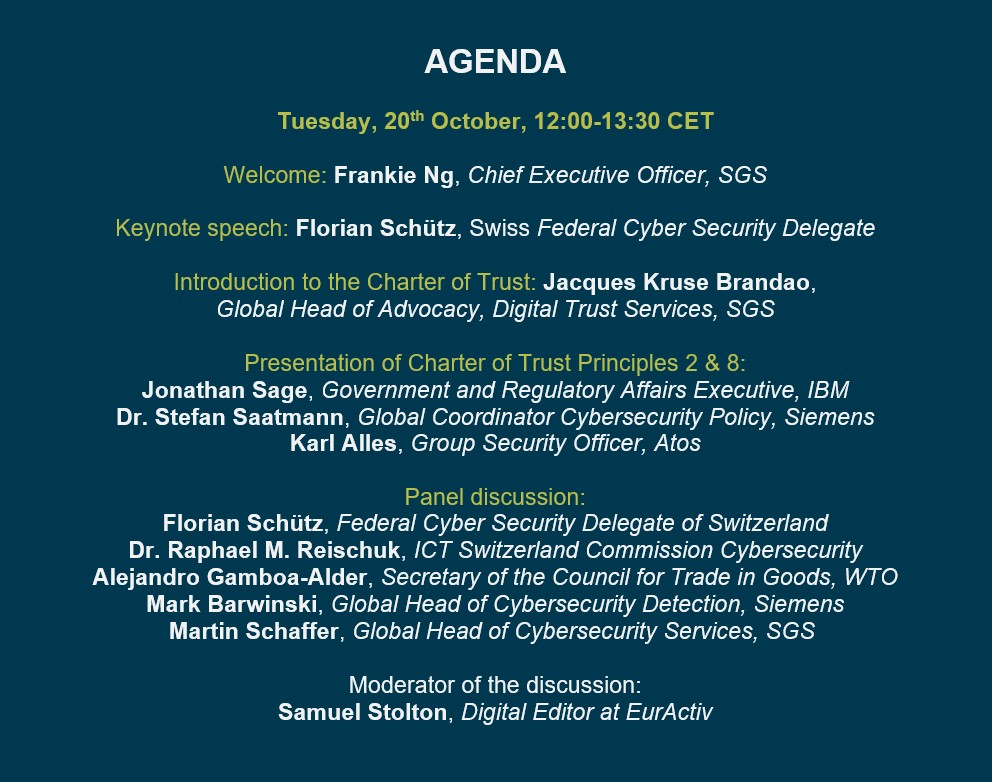

PREVIOUS POST
New Chairwoman for the Global External Engagement Group
NEXT POST
Decrypting the Future: Global Timelines for PostQuantum Cryptography and why they matter

You may also like

 Post-Quantum Cryptography
Decrypting the Future: Global Timelines for PostQuantum Cryptography and why they matter
The transition to post-quantum cryptography is not a future problem — it is a present one. The threat of adversaries harvesting encrypted data today for decryption once quantum computing matures means that organizations with long-lived data and systems are already exposed. Waiting for cryptographically relevant quantum computers to arrive before acting is not a viable risk management strategy.
Exposure is not uniform across sectors. Financial services, government and defense, operational technology, and healthcare face the sharpest quantum risk, driven by decades-long data retention obligations, slow system replacement cycles, and the societal consequences of cryptographic failure. For these sectors, PQC readiness has moved from best practice to strategic imperative.
Globally, the direction of travel is clear. The United States, European Union, United Kingdom, Singapore, and Australia have each established structured PQC transition frameworks, with mandatory deadlines converging around the late 2020s and 2030. Organizations operating across jurisdictions should expect compounding compliance requirements and align migration plans accordingly.
At the same time, the geopolitical dimension of PQC standardization is becoming increasingly salient. The emergence of a “splinternet” infrastructure, characterized by regionally fragmented digital ecosystems, suggests that cryptographic standards diverge along political and strategic lines. As a result, organizations must not only manage technical migration but also navigate a politically charged landscape in which interoperability, regulatory alignment, and long-term cryptographic agility become critical strategic considerations.
This paper offers a comparative overview of regional PQC transition frameworks and identifies the business and systemic risks associated with quantum-vulnerable cryptography, providing insights for organizations preparing for the transition to post-quantum cryptography. Overall, PQC migration is a strategic transformation, not a technical patch. Cryptographic inventory, governance structures, crypto-agility, and supply chain engagement are as central to success as algorithm selection — and organizations that treat PQC readiness as an architectural and organizational challenge will be best positioned as quantum risks continue to mature.
Exposure is not uniform across sectors. Financial services, government and defense, operational technology, and healthcare face the sharpest quantum risk, driven by decades-long data retention obligations, slow system replacement cycles, and the societal consequences of cryptographic failure. For these sectors, PQC readiness has moved from best practice to strategic imperative.
Globally, the direction of travel is clear. The United States, European Union, United Kingdom, Singapore, and Australia have each established structured PQC transition frameworks, with mandatory deadlines converging around the late 2020s and 2030. Organizations operating across jurisdictions should expect compounding compliance requirements and align migration plans accordingly.
At the same time, the geopolitical dimension of PQC standardization is becoming increasingly salient. The emergence of a “splinternet” infrastructure, characterized by regionally fragmented digital ecosystems, suggests that cryptographic standards diverge along political and strategic lines. As a result, organizations must not only manage technical migration but also navigate a politically charged landscape in which interoperability, regulatory alignment, and long-term cryptographic agility become critical strategic considerations.
This paper offers a comparative overview of regional PQC transition frameworks and identifies the business and systemic risks associated with quantum-vulnerable cryptography, providing insights for organizations preparing for the transition to post-quantum cryptography. Overall, PQC migration is a strategic transformation, not a technical patch. Cryptographic inventory, governance structures, crypto-agility, and supply chain engagement are as central to success as algorithm selection — and organizations that treat PQC readiness as an architectural and organizational challenge will be best positioned as quantum risks continue to mature.
Read more
April 07, 2026
•
Post-Quantum Cryptography
A Quantum Leap for Cybersecurity: The Charter of Trust’s PQC Ambition
The Charter of Trust is taking decisive steps to secure our digital future in the quantum era. As quantum computing advances, the risks to today’s cryptographic systems grow ever more urgent. Our dedicated working group is leading the way in raising awareness, promoting standards-based migration, and fostering collaboration across industries, governments, and academia. Together, we are committed to a proactive, well-coordinated, and risk-driven transition to post-quantum cryptography—ensuring digital trust and resilience for generations to come. Discover our vision and join us as we shape a secure digital world for the quantum age.
Read more
November 03, 2026
•
 Artificial Intelligence
Read the Charter's contribution to the European Commission's public consultation on the Digital Omnibus Package
The rapid expansion of EU digital regulation has strengthened security, privacy, and trust, but it has also created overlapping obligations, inconsistent timelines, and administrative complexity. The Digital Omnibus Package provides a timely opportunity to streamline these rules, ensure greater coherence, and enable businesses to focus resources on resilience and innovation rather than redundant compliance tasks.
The Charter of Trust welcomes the Commission’s initiative to harmonize digital regulations across the EU, aiming to reduce administrative burdens while maintaining high standards of security and privacy. Representing the unified views of its Partners, this paper addresses all key legislation within the scope of the Digital Omnibus and offers comprehensive recommendations. It emphasizes the need for a unified incident reporting system, risk-based notification requirements, and fair compliance processes to minimize regulatory overlap. The Charter calls for clearer liability clauses, global recognition of certifications, and stronger supply chain security.
In data regulation, the Charter advocates ensuring alignment between the rules on data intermediation services under the DGA and B2B data sharing under the Data Act and extending exemptions to mid-cap companies, all while safeguarding trade secrets. For artificial intelligence, the paper recommends a phased approach to new requirements, integrated conformity assessments, harmonized compliance templates, and clear definitions, supported by sector-specific guidance and transparent AI categorization. The Charter also encourages the European Commission to ensure that ePrivacy reform is future-proof, fosters innovation, and reflects the needs of both businesses and consumers. Finally, it recommends robust security standards and cross-border recognition for the EU Business Wallet, with industry involvement in technical standards and integration with data access systems.
Collectively, these measures are designed to foster innovation, resilience, and trust in the EU’s digital landscape, allowing businesses to thrive in a coherent and future-ready regulatory environment.
The Charter of Trust welcomes the Commission’s initiative to harmonize digital regulations across the EU, aiming to reduce administrative burdens while maintaining high standards of security and privacy. Representing the unified views of its Partners, this paper addresses all key legislation within the scope of the Digital Omnibus and offers comprehensive recommendations. It emphasizes the need for a unified incident reporting system, risk-based notification requirements, and fair compliance processes to minimize regulatory overlap. The Charter calls for clearer liability clauses, global recognition of certifications, and stronger supply chain security.
In data regulation, the Charter advocates ensuring alignment between the rules on data intermediation services under the DGA and B2B data sharing under the Data Act and extending exemptions to mid-cap companies, all while safeguarding trade secrets. For artificial intelligence, the paper recommends a phased approach to new requirements, integrated conformity assessments, harmonized compliance templates, and clear definitions, supported by sector-specific guidance and transparent AI categorization. The Charter also encourages the European Commission to ensure that ePrivacy reform is future-proof, fosters innovation, and reflects the needs of both businesses and consumers. Finally, it recommends robust security standards and cross-border recognition for the EU Business Wallet, with industry involvement in technical standards and integration with data access systems.
Collectively, these measures are designed to foster innovation, resilience, and trust in the EU’s digital landscape, allowing businesses to thrive in a coherent and future-ready regulatory environment.
Read more
October 14, 2025
•


