
On 27 May, over 100 attendees dialed in from Asia, Africa, the US, and Europe for the Charter of Trust’s online roadshow: “Stronger cybersecurity during the COVID-19 pandemic.”
The session was introduced by Pierre Barnabé, SEVP Cybersecurity in Atos, painting the context of the Charter of Trust’s creation and emphasizing how critical it is to set the scene and educate people to develop cyber protection.
Focused on European policies, the conversation was led by Jakub Boratyński Acting Director for Digital Society, Trust and Cybersecurity, DG CNECT. During his keynote session he presented EU cybersecurity policy actions in 2020 among which the review of the Network and Information Security Directive being an important policy action – in this context he highlighted the importance of services delivered online in particular during the COVID-19 crisis which has shown how essential digital infrastructures across all walks of life have become.
Our panel discussion welcomed our key panelist Georgios Chatzichristos, Network and Information Security Officer at ENISA, followed by several representatives of Charter of Trust. ENISA walked us through the initiatives they have undertaken to provide cybersecurity guidance for people working from home.
The panel discussion highlighted the necessity of collaboration, particularly in the area of better information and threat intelligence sharing. The first panel discussion focused on the recently started threat intelligence initiative within the Charter of Trust – Principle 8, in which partners will work out how they can most effectively learn from each other by sharing indications of compromise from different industry sectors and outwit or cyber security adversaries.
The second discussion highlighted the work the Charter has done on cyber security education, our Principle 6, in particular the focus on helping small and medium sized enterprises with the cyber security handbook which the Charter recently published. The dialogue also focused on the important work that the Charter is leading on Security by Default, Principle 3, setting out requirements and recommendations for baking security in at the core of products and services.
In the final round of closing comments, speakers emphasized how trust is more needed than ever and how cybersecurity is the key success factor for digitization, which is more crucial than ever before as businesses and government have moved quickly to new ways of providing services and doing business. Better cybersecurity must underpin these new business models and the Charter of Trust is more relevant than ever in terms of its goals and objectives. If you would like more information on any of the above initiatives, please contact us.
Stay tuned for more Charter of Trust virtual events. Similar online roadshows are planned in Tokyo and Washington D.C., as well as deep-dive webinars on the Charter of Trust Principles such as “Education,” “Security by Default,” and “Transparency and Response.”

Georgios Chatzichristos, Network and Information Security Officer at ENIS

Jakub Boratyński, Acting Director for Digital Society, Trust and Cybersecurity, DG CNECT

PREVIOUS POST
Charter of Trust elects new co-chairs of the Board of Directors
NEXT POST
A Quantum Leap for Cybersecurity: The Charter of Trust’s PQC Ambition

You may also like

 Emerging Technologies
A Quantum Leap for Cybersecurity: The Charter of Trust’s PQC Ambition
The Charter of Trust is taking decisive steps to secure our digital future in the quantum era. As quantum computing advances, the risks to today’s cryptographic systems grow ever more urgent. Our dedicated working group is leading the way in raising awareness, promoting standards-based migration, and fostering collaboration across industries, governments, and academia. Together, we are committed to a proactive, well-coordinated, and risk-driven transition to post-quantum cryptography—ensuring digital trust and resilience for generations to come. Discover our vision and join us as we shape a secure digital world for the quantum age.
Read more
October 06, 2026
•
 Emerging Technologies
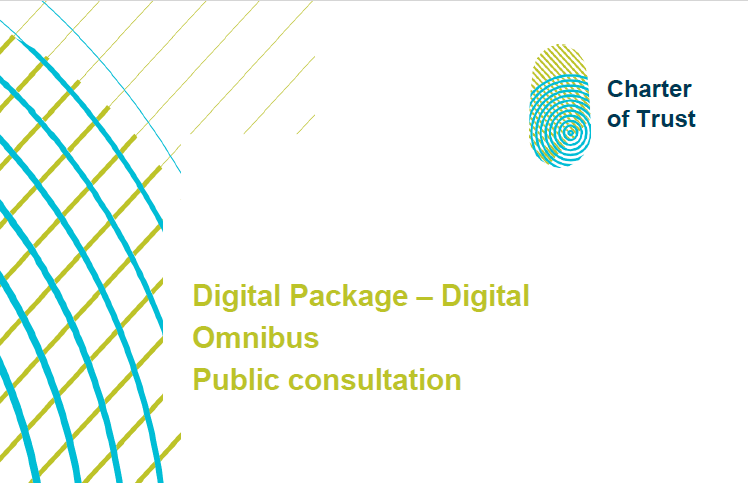
Read the Charter's contribution to the European Commission's public consultation on the Digital Omnibus Package
The rapid expansion of EU digital regulation has strengthened security, privacy, and trust, but it has also created overlapping obligations, inconsistent timelines, and administrative complexity. The Digital Omnibus Package provides a timely opportunity to streamline these rules, ensure greater coherence, and enable businesses to focus resources on resilience and innovation rather than redundant compliance tasks.
The Charter of Trust welcomes the Commission’s initiative to harmonize digital regulations across the EU, aiming to reduce administrative burdens while maintaining high standards of security and privacy. Representing the unified views of its Partners, this paper addresses all key legislation within the scope of the Digital Omnibus and offers comprehensive recommendations. It emphasizes the need for a unified incident reporting system, risk-based notification requirements, and fair compliance processes to minimize regulatory overlap. The Charter calls for clearer liability clauses, global recognition of certifications, and stronger supply chain security.
In data regulation, the Charter advocates ensuring alignment between the rules on data intermediation services under the DGA and B2B data sharing under the Data Act and extending exemptions to mid-cap companies, all while safeguarding trade secrets. For artificial intelligence, the paper recommends a phased approach to new requirements, integrated conformity assessments, harmonized compliance templates, and clear definitions, supported by sector-specific guidance and transparent AI categorization. The Charter also encourages the European Commission to ensure that ePrivacy reform is future-proof, fosters innovation, and reflects the needs of both businesses and consumers. Finally, it recommends robust security standards and cross-border recognition for the EU Business Wallet, with industry involvement in technical standards and integration with data access systems.
Collectively, these measures are designed to foster innovation, resilience, and trust in the EU’s digital landscape, allowing businesses to thrive in a coherent and future-ready regulatory environment.
The Charter of Trust welcomes the Commission’s initiative to harmonize digital regulations across the EU, aiming to reduce administrative burdens while maintaining high standards of security and privacy. Representing the unified views of its Partners, this paper addresses all key legislation within the scope of the Digital Omnibus and offers comprehensive recommendations. It emphasizes the need for a unified incident reporting system, risk-based notification requirements, and fair compliance processes to minimize regulatory overlap. The Charter calls for clearer liability clauses, global recognition of certifications, and stronger supply chain security.
In data regulation, the Charter advocates ensuring alignment between the rules on data intermediation services under the DGA and B2B data sharing under the Data Act and extending exemptions to mid-cap companies, all while safeguarding trade secrets. For artificial intelligence, the paper recommends a phased approach to new requirements, integrated conformity assessments, harmonized compliance templates, and clear definitions, supported by sector-specific guidance and transparent AI categorization. The Charter also encourages the European Commission to ensure that ePrivacy reform is future-proof, fosters innovation, and reflects the needs of both businesses and consumers. Finally, it recommends robust security standards and cross-border recognition for the EU Business Wallet, with industry involvement in technical standards and integration with data access systems.
Collectively, these measures are designed to foster innovation, resilience, and trust in the EU’s digital landscape, allowing businesses to thrive in a coherent and future-ready regulatory environment.
Read more
October 14, 2025
•
 General announcements
Charter of Trust Welcomes Zscaler
We are thrilled to announce that we welcome Zscaler as the newest Partner to the Charter of Trust!
Zscaler is a leading cloud enterprise security provider helping global businesses accelerate their digital transformation by becoming more agile, efficient, resilient, and secure.
With Zscaler as a partner in the Charter of Trust, we aim to strengthen global cyber resilience through trust – by fostering actionable collaboration between industry leaders, governments, and public-private platforms. Zscaler brings robust expertise and innovation to the table, making it the ideal partner to drive this mission forward.
“Zscaler is excited to drive meaningful change alongside our new partners, laying a foundation of trust essential for successful digital transformation,” said Sam Curry, Zscaler CISO. “In today’s world, the need for reducing inherent trust and default access has never been greater. To truly stay ahead of ever-evolving threats, we must unite as a coalition of practitioners. Cyber attackers aren’t taking breaks, and with advancements like artificial intelligence, quantum cryptography, and emerging technologies on the horizon, collaboration is the key to securing the future.”
“We are proud to welcome Zscaler to the Charter of Trust. Their focus on cybersecurity innovation and commitment to openness reflect our shared ambition to create a safer, more resilient digital future. Together, we’ll strengthen trust, transparency, and security across the global digital landscape.” highlighted Dr. Summit Chada, Charter of Trust Co-Chair and COO Group Security & Business Lines CISO at Atos.
“With Zscaler as a Partner of the Charter of Trust, we believe that we can strengthen the global commitment to secure digital transformation by combining technological innovation with the Charter of Trust’s collaborative approach to cybersecurity leadership.” Ralf Schneider, Charter of Trust Co-Chair and Senior Fellow and Head of Cybersecurity and NextGenIT Think Tank at Allianz SE, welcomes Zscaler to the Charter of Trust.
We are excited to join forces and work together to advance digital trust and security across industries.
Zscaler is a leading cloud enterprise security provider helping global businesses accelerate their digital transformation by becoming more agile, efficient, resilient, and secure.
With Zscaler as a partner in the Charter of Trust, we aim to strengthen global cyber resilience through trust – by fostering actionable collaboration between industry leaders, governments, and public-private platforms. Zscaler brings robust expertise and innovation to the table, making it the ideal partner to drive this mission forward.
“Zscaler is excited to drive meaningful change alongside our new partners, laying a foundation of trust essential for successful digital transformation,” said Sam Curry, Zscaler CISO. “In today’s world, the need for reducing inherent trust and default access has never been greater. To truly stay ahead of ever-evolving threats, we must unite as a coalition of practitioners. Cyber attackers aren’t taking breaks, and with advancements like artificial intelligence, quantum cryptography, and emerging technologies on the horizon, collaboration is the key to securing the future.”
“We are proud to welcome Zscaler to the Charter of Trust. Their focus on cybersecurity innovation and commitment to openness reflect our shared ambition to create a safer, more resilient digital future. Together, we’ll strengthen trust, transparency, and security across the global digital landscape.” highlighted Dr. Summit Chada, Charter of Trust Co-Chair and COO Group Security & Business Lines CISO at Atos.
“With Zscaler as a Partner of the Charter of Trust, we believe that we can strengthen the global commitment to secure digital transformation by combining technological innovation with the Charter of Trust’s collaborative approach to cybersecurity leadership.” Ralf Schneider, Charter of Trust Co-Chair and Senior Fellow and Head of Cybersecurity and NextGenIT Think Tank at Allianz SE, welcomes Zscaler to the Charter of Trust.
We are excited to join forces and work together to advance digital trust and security across industries.
Read more
September 29, 2025
•